It Wasn't the First Time
- Krystal Geddes
- Jun 6
- 7 min read

At a recent Sexual Assault Awareness and Prevention Month (SAAPM) event, a Senior Military Leader asked me, "What keeps you up at night about SAPR?"
I had my answer before the question was finished. What keeps me up at night is that roughly half of people who experience military sexual trauma (MST) carry a history of pre-service sexual victimization. Half had already survived it once.
In 2023, the Department of Defense Sexual Assault Prevention and Response Office reported that nearly 7% of active duty women and just over 1% of active duty men experienced unwanted sexual contact, about 29,000 service members (15,200 women, 13,800 men). The reporting rate rose from 20% in 2021 to 25% in 2023, meaning 75% of incidents still go unreported.
In my role as a Sexual Assault Response Coordinator, I oversee a regional Sexual Assault Prevention and Response (SAPR) program for the United States Marine Corps. We provide case management, trauma-informed advocacy and response, and prevention through education. Early in my role, I noticed a disturbing trend. Many of the survivors I sat with said the same thing. This was not their first experience with sexual violence. Why is it that so many adult survivors were also survivors as children?
To answer this question, I dug into what we actually know about sexual revictimization during U.S. military service. I worked through fourteen studies. The limited research available confirmed what I was seeing.
What I found
Women carry the higher burden, and men remain nearly invisible in the data
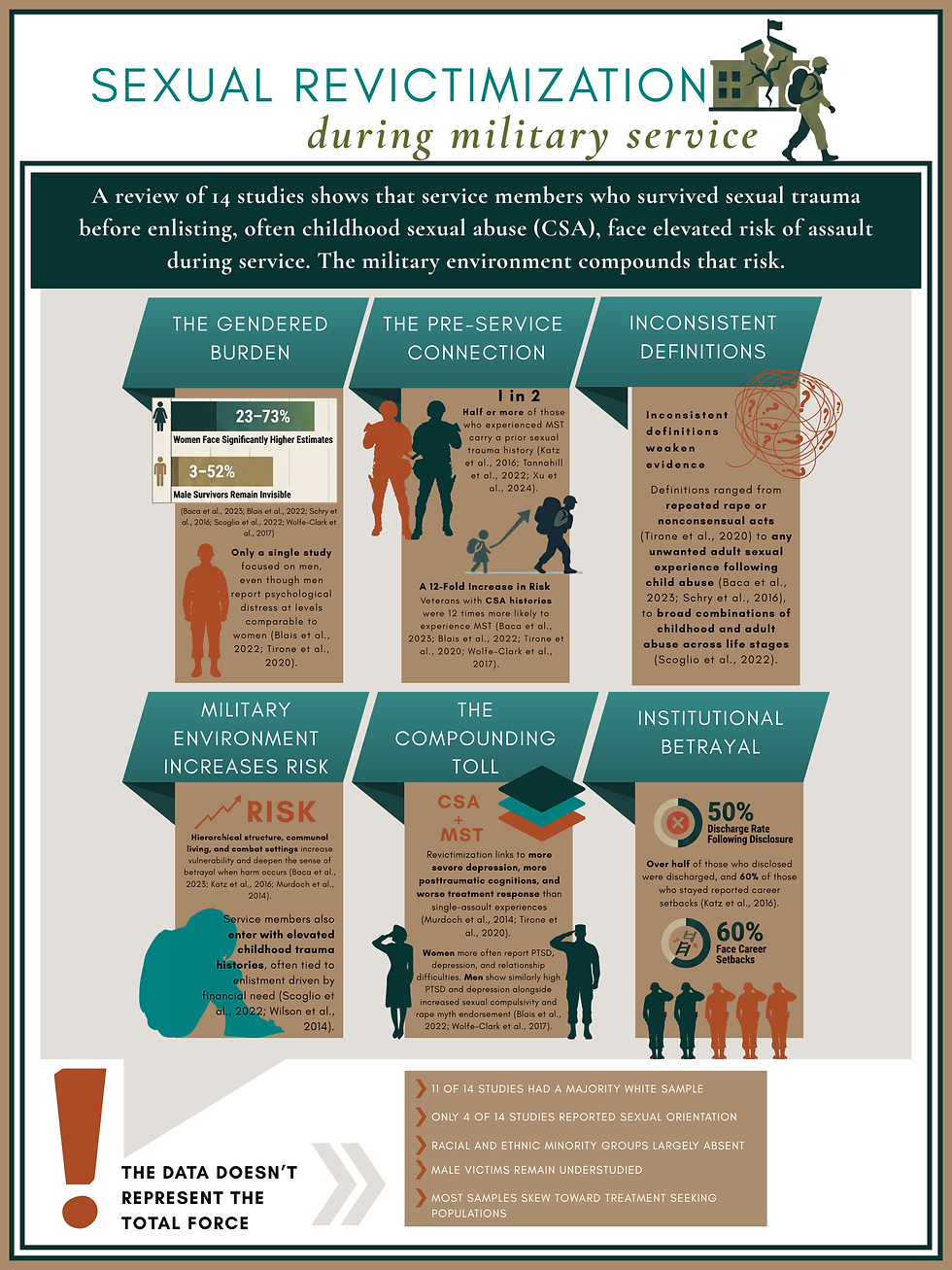
Revictimization runs higher for women across studies, with estimates from 23 to 73%, compared to 3 to 52% for men (Baca et al., 2023; Blais et al., 2022; Schry et al., 2016; Scoglio et al., 2022; Wolfe-Clark et al., 2017). The wide ranges reflect differences in sampling, study design, and reliance on treatment-seeking populations rather than true disagreement about scope (Scoglio et al., 2022; Tirone et al., 2020; Xu et al., 2024).
One pattern is hard to ignore. Only a single study focused specifically on revictimized male veterans, even though men report psychological distress at levels comparable to women (Blais et al., 2022; Tirone et al., 2020).
Childhood sexual abuse is the strongest signal we have
Premilitary sexual trauma predicted revictimization during service. Veterans with childhood sexual abuse histories were 12 times more likely to experience MST (Baca et al., 2023; Blais et al., 2022; Tirone et al., 2020; Wolfe-Clark et al., 2017).
Service members also report higher rates of childhood and adult sexual victimization than civilians do (Bostock & Daley, 2007; Wilson et al., 2014). Multiple studies found that half or more of those who experienced MST carried a prior sexual trauma history (Katz et al., 2016; Tannahill et al., 2022; Xu et al., 2024).
Researchers do not define revictimization the same way, which weakens the evidence base
Definitions ranged from repeated rape or nonconsensual acts (Tirone et al., 2020) to any unwanted adult sexual experience following child abuse (Baca et al., 2023; Schry et al., 2016), to broad combinations of childhood and adult abuse across life stages (Scoglio et al., 2022).
Several studies never defined the term at all and only implied it through study design, as Wilson et al. (2014) did by framing the work around childhood sexual abuse predicting MST (Tannahill et al., 2022; Tirone et al., 2020). Inconsistent definitions make it difficult to compare findings or pool estimates.
The military environment raises the risk rather than buffering it
Hierarchical structure, communal living, and combat settings increase vulnerability and deepen the sense of betrayal when harm occurs (Baca et al., 2023; Katz et al., 2016; Murdoch et al., 2014). Revictimization in this context combines interpersonal and institutional betrayal, which tracks with severe outcomes including PTSD, depression, and suicidality (Baca et al., 2023).
Service members also enter with elevated childhood trauma histories, often tied to enlistment driven by financial need (Scoglio et al., 2022; Wilson et al., 2014). Hypermasculine norms, stigma, and fear of retaliation suppress reporting for both men and women (Scoglio et al., 2022; Wolfe-Clark et al., 2017).
The outcomes compound
Revictimization links to more severe depression, more posttraumatic cognitions, and worse treatment response than single-assault experiences (Murdoch et al., 2014; Tirone et al., 2020). PTSD symptoms and suicide risk climb among those with combined childhood and military trauma histories (Baca et al., 2023; Blais et al., 2022; Bryan et al., 2015; Tannahill et al., 2022; Xu et al., 2024).
Women more often report PTSD, depression, and relationship difficulties. Men show similarly high PTSD and depression alongside increased sexual compulsivity and rape myth endorsement (Blais et al., 2022; Wolfe-Clark et al., 2017).
Survivors stay silent for reasons the institution creates
Fear of retaliation, career damage, and pressure to protect unit cohesion drive low reporting (Baca et al., 2023; Katz et al., 2016). Men avoid disclosure to preserve a masculine self-image, sometimes reframing the experience as hazing to maintain a sense of control (Scoglio et al., 2022; Wolfe-Clark et al., 2017).
The consequences are concrete. Over half of those who disclosed were discharged, and 60% of those who stayed reported career setbacks (Katz et al., 2016). Low confidence in leadership and stigma around seeking care deepen the silence (Katz et al., 2016).
The data does not represent the total force
Eleven of the fourteen studies drew on majority-white samples, against an active-duty population that is about 70% white. Sexual orientation diversity is thinner still. Only four studies reported it at all, and most samples were majority heterosexual.
Gender split more evenly, with six male-majority samples, five female-majority, and two mixed. The pattern is clear on race and on sexual orientation. The prevalence figures we have describe a narrow slice of those who serve, and we cannot assume they hold for everyone.
Why this matters, and what we owe survivors
Sexual revictimization is common among those who survived sexual trauma before they ever raised their right hand. The people most at risk arrive already carrying it. That changes what prevention has to do, and it changes who we are protecting.
We need to identify the true prevalence among service members. Right now, the estimates swing too wide to plan around, and a number we cannot pin down is a number we cannot fund, staff, or build policy against. Better data is the foundation for better prevention.
We need to grasp the full scope, because revictimization does not simply repeat the harm. It compounds it. Survivors with both childhood and military sexual trauma carry heavier PTSD, deeper depression, and higher suicide risk than those with a single experience. When we underestimate how often this happens, we underestimate how much harm we are failing to prevent.
And we need to understand why it happens. The answer is not only individual history. It is the environment we operate in, the culture that silences disclosure, and the institution that too often betrays the people it asks to serve. Once we see those mechanisms clearly, we can act on them. As responders within the institution, that understanding is what lets us write protective policies, build prevention that reaches the people who need it first, and deliver trauma-informed responses from SAPR staff, providers, and leaders trained to recognize the pattern and act on it.
The institution's ability to protect service members from sexual violence determines the successful recruitment, operational readiness, and retention the organization depends on. It is the responsibility of those of us who care for survivors to continue to advocate for positive change and institutional accountability to protect those who need it most.
References
Baca, S. A., Crawford, J. N., & Allard, C. B. (2023). PTSD, depression, and suicidality among survivors of childhood sexual trauma (CST), military sexual trauma (MST), and sexual revictimization (CST + MST). Psychological Trauma: Theory, Research, Practice, and Policy, 15(8), 1271–1279. https://doi.org/10.1037/tra0001149
Blais, R. K., Livingston, W. S., Barrett, T. S., & Tannahill, H. S. (2022). Sexual violence in military service members/veterans individual and interpersonal outcomes associated with single and multiple exposures to civilian and military sexual violence. Journal of Interpersonal Violence, 38(3-4), 2585–2613. https://doi.org/10.1177/08862605221101197
Bostock, D. J., & Daley, J. G. (2007). Lifetime and current sexual assault and harassment victimization rates of active-duty United States Air Force women. Violence Against Women, 13(9), 927–944. https://doi.org/10.1177/1077801207305232
Bryan, C. J., Bryan, A. O., & Clemans, T. A. (2015). The association of military and premilitary sexual trauma with risk for suicide ideation, plans, and attempts. Psychiatry Research, 227(2-3), 246–252. https://doi.org/10.1016/j.psychres.2015.01.030
Department of Defense, Office of People Analytics (OPA), & Sexual Assault Prevention and Response Office (SAPRO). (2024). Department of Defense annual report on sexual assault in the military (Fiscal Year 2023) [PDF]. https://www.sapr.mil/sites/default/files/public/docs/reports/AR/FY23/FY23_Annual_Report.pdf
Katz, L. S., Huffman, C., & Cojucar, G. (2016). In her own words: Semi-structured interviews of women veterans who experienced military sexual assault. Journal of Contemporary Psychotherapy, 47(3), 181–189. https://doi.org/10.1007/s10879-016-9349-0
Murdoch, M., Polusny, M. A., Street, A., Noorbaloochi, S., Simon, A. B., Bangerter, A., Grill, J., & Voller, E. (2014). Sexual assault during the time of gulf war i: A cross-sectional survey of U.S. service men who later applied for department of veterans affairs PTSD disability benefits. Military Medicine, 179(3), 285–293. https://doi.org/10.7205/milmed-d-12-00513
Schry, A. R., Beckham, J. C., The VA Mid-Atlantic MIRECC Workgroup, & Calhoun, P. S. (2016). Sexual revictimization among Iraq and Afghanistan war era veterans. Psychiatry Research, 240, 406–411. https://doi.org/10.1016/j.psychres.2016.04.016
Scoglio, A. J., Molnar, B. E., Lincoln, A. K., Griffith, J., Park, C., & Kraus, S. W. (2022). Sexual and physical revictimization in U.S. military veterans. Journal of Traumatic Stress, 35(4), 1129–1141. https://doi.org/10.1002/jts.22816
Tannahill, H. S., Barrett, T. S., Zalta, A. K., Tehee, M., & Blais, R. K. (2022). Posttraumatic cognitions differ between men and women after military sexual assault revictimization in their contribution to PTSD symptoms. Journal of Interpersonal Violence, 38(7-8), 6038–6061. https://doi.org/10.1177/08862605221127211
Tirone, V., Smith, D., Steigerwald, V. L., Bagley, J. M., Brennan, M., Van Horn, R., Pollack, M., & Held, P. (2021). Examining the impact of sexual revictimization in a sample of veterans undergoing intensive PTSD treatment. Journal of Interpersonal Violence, 36(23-24), 10989–11008. https://doi.org/10.1177/0886260519897333
Wilson, L. C., Kimbrel, N. A., Meyer, E. C., Young, K. A., & Morissette, S. B. (2014). Do child abuse and maternal care interact to predict military sexual trauma? Journal of Clinical Psychology, 71(4), 378–386. https://doi.org/10.1002/jclp.22143
Wolfe-Clark, A. L., Bryan, C. J., Bryan, A. O., Reynolds, M. L., Fuessel-Herrmann, D., White, K. L., & Harris, J. A. (2017). Child sexual abuse, military sexual trauma, and psychological distress among male military personnel and veterans. Journal of Child & Adolescent Trauma, 10(2), 121–128. https://doi.org/10.1007/s40653-017-0144-1
Xu, B., Blais, R. K., & Tannahill, H. (2024). Negative posttraumatic cognitions about self potentially mediate the relation between sexual revictimization and suicide risk in a sample of military sexual assault survivors. Psychological Trauma: Theory, Research, Practice, and Policy, 17(4), 777–785. https://doi.org/10.1037/tra0001656
Comments